One of the questions I still find surprisingly hard to answer is:
So, what do you actually do?
You'd think after all these years I have a killer one-liner everyone understands immediately, but... no.
I usually say something like, "I build communities in tech," and then I can see the tiny pause while the person decides whether that means social media, events, customer support, marketing, or me managing a Discord all day.
Fair enough. 😆
Having one of those weeks where I did a little bit of everything and it honestly has been so fun. Community will always be that role for me.
— Pauline P. Narvas (@paw_lean) January 29, 2026
Community building can be hard to explain because it often looks different depending on the company, the product, the audience, and the business model.
It can really be some of these things, or all of these things:
- helping someone get unstuck
- designing a better place for people to learn from each other
- creating advocates
- running events
- building feedback loops
- supporting customers
- helping a product feel less faceless (because people buy from people)
I also keep seeing this come up in conversations with founders and startups. Everyone has a slightly different take on community and DevRel / DX as a job, and as a function.
I’ve enjoyed having consultation chats with startups about all things community/dx/DevRel recently. Always a lot of fun realising how everyone has such a different take on it as a job, and as a function.
— Pauline P. Narvas (@paw_lean) May 26, 2026
So I started wondering if the job market itself could help answer the question.
I was looking through the Community Inc jobs board recently, as one does when they can't stop thinking about community...
The page describes itself as a collection of roles "at the intersection of community and business," and that phrase really stuck with me! Because when I scrolled through the jobs, I quickly realised something:
Community is not one job anymore
There are:
- Community Managers
- Community Growth Managers
- Community & Field Marketing Leads
- Customer Advocacy Specialists
- Heads of Community
- Community Operations Managers
- Directors of Community & Customer Marketing
... They all have "community" somewhere in the title, but they are not all doing the same job.
Some are marketing roles. Some are customer success roles. Some are DevRel / DX roles. Some are growth roles. Some are events, content, advocacy, education, or partnerships roles.
Community has become a GTM function.
Or maybe more accurately: community has become a layer across the entire GTM org.
Which is why, at the end of last year, I tweeted this:
My prediction for 2026 is community
— Pauline P. Narvas (@paw_lean) December 28, 2025
Community across the funnel
The traditional marketing funnel is not perfect, but this is what I usually use to explain community roles. If you map these roles across awareness, acquisition, activation, retention, advocacy, and expansion, the job market starts to make a lot more sense.
The community role map
One community function, many possible GTM jobs.
Awareness: attention and trust
At the top of the funnel, community is about attention and trust.
This is where you see roles like:
- Community & Field Marketing Lead
- Events and Community Manager
- Brand Community Manager
- Community & Content Marketing Manager
- Head of Influencers & Community
- Global Social Media and Community
These roles are about showing up where your audience already is. Events, social, content, creator relationships, local activations, meetups, and all the moments that make a company feel present in the market.
I lived a lot of this at Gitpod.
When I joined them in 2021, I was officially moving into community and DevRel / DX full-time.
In reality, I was doing a bit of everything: building the community, creating content, hosting events, running meetups, working on DevX Conf, speaking at KubeCon, and helping more developers understand Cloud Development Environments.
Huge fan of Pauline and how she's elevating communities globally. I need to open a job posting whose sole responsibility is to "keep up with Pauline". A true force of nature.
— Taz Singh, Founder, Guild
At the time, I might not have called it "top-of-funnel community," but looking back, that is exactly what some of it was.
Most of what I did there was to help people discover Gitpod, understand the category, and give the product a human face.
Tweet from Pauline about putting a human face to the product
Tweet from Ivan Burazin about community and category-building
Acquisition: community as a growth engine
Then there are community roles focused on growth.
These are titles like:
- Community Growth Manager
- Network Growth Manager
- Ecosystem Growth Manager
- Community-Led Growth Lead
- Campus Community Growth Manager
- Ambassador & Partnerships Community Growth Manager
This is community as a growth engine.
Ambassador programs, campus communities, regional groups, partner ecosystems, creator loops, and community-led campaigns all sit here.
I loved this framing from Grace Clarke because it names the thing I see more companies starting to understand: community can be a managed system, a lifecycle motion, and a growth engine all at once.
Tweet from Grace Clarke about community as a machine to manage and a growth engine
Again, I saw this at Gitpod through our Community Heroes, meetups, and open source roots. The community was not just a place where people hung out. It helped people find us, trust us, try the product, and bring others along.
That is the magic of community-led growth when it works.
Tweet from Pauline about community-led growth
It usually doesn't feel like a funnel to the people inside it, it's momentum.
Activation: helping people get to value faster
Some roles are about helping people get to value faster.
This is where you see:
- Technical Community Manager
- Developer Community Manager
- Developer Relations Engineer
- Customer Education and Communities Manager
- Head of Education & Community
- Community Program Manager
This has always been one of my favourite parts of the work.
If you’re on the member side of one of these programmes, I’ve also written about how to make the most of the opportunity.
Back in 2016, when I was teaching with Code First Girls, activation looked like helping women build their first websites and realise that tech could be for them.
At Gitpod, it looked like helping developers get from "what is a CDE?" to "oh, I can actually use this in my workflow."
At Vercel, it looked like helping builders get their projects into production, understand the ecosystem, find the right path when they got stuck, and become experts.
Tweet from Pauline about helping builders get unstuck
And now at OpenAI, this is the part I am most excited to keep exploring, especially in such a new space: helping developers feel confident, supported, and excited to build with tools that are changing very quickly.
The best community and DevRel / DX work I have done has always come from being close to the product and close to the people using it.
Retention: keeping people connected and supported
This is the classic community bucket.
The roles here look like:
- Community Manager
- Community Engagement Manager
- Community Experience Manager
- Community Operations Manager
- Online Community Manager
- Discord, Reddit, or Slack Community Manager
This is the work people often imagine when they hear "community." A day-to-day could include:
- Welcoming people
- Answering questions
- Designing rituals
- Keeping spaces healthy and aligned with the Code of Conduct
- Creating reasons for people to come back
- Making sure nobody is shouting into the void
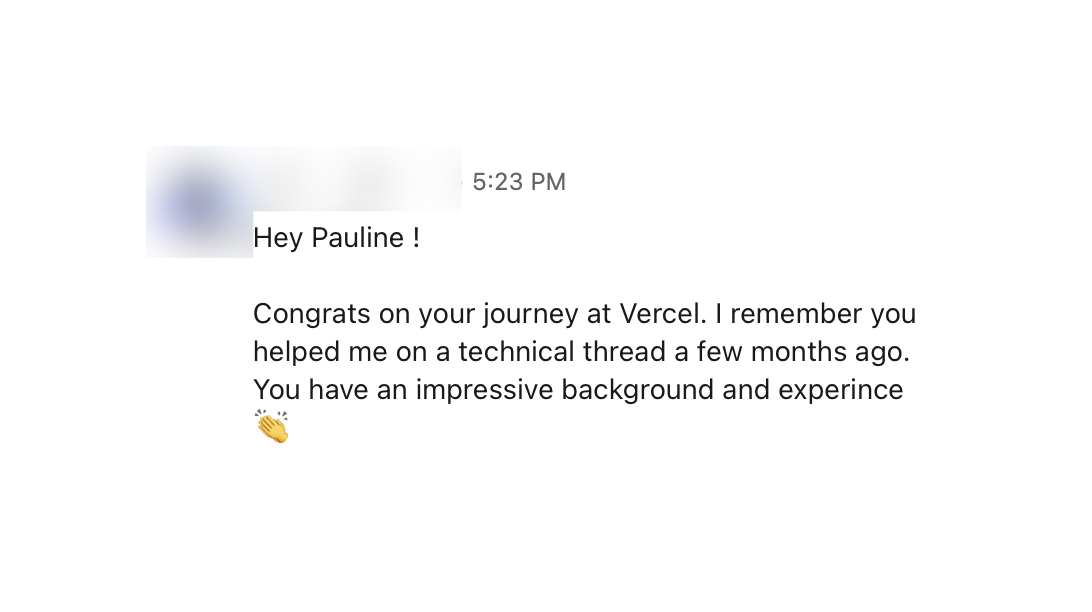
At Vercel, I came to think about community work across three layers:
- the moments that make people feel seen
- the systems that make care repeatable
- the learning loops that help people become experts
Thanks! And great questions! I'm bringing 10+ years of web dev coding and debugging skills to help everyone in the Vercel Community succeed 😄
— Amy Egan (@AmyAEgan) July 13, 2022
And I want to see the community continue to grow into a place where more of us can help each other build amazing things
Retention lives across all three.
It is the public reply that helps someone feel less stuck, the workflow that makes sure no post sits unanswered, the repeated question that tells you something in the docs, onboarding, or product experience needs attention.
This is where community becomes more than vibes.
It becomes signal.
Every interaction counts, especially when people are learning something new.
Advocacy: turning users into champions
Then there are roles focused on turning users, customers, developers, or partners into champions.
Titles like:
- Customer Advocacy Specialist
- Developer Community Advocate
- Community Evangelist
- Ambassador Program Manager
- VIP Community Manager
This is community as proof.
The best advocates are not manufactured, they are nurtured. They had a good experience, felt seen, got value, trusted the team, and wanted to bring others with them.
At Gitpod, I saw this in community members who hosted meetups, built extensions, contributed ideas, and showed up for us again and again.
At Vercel, I saw it in builders sharing what they made, helping each other, joining events, giving feedback, and becoming part of the wider ecosystem.
Potentially hot take: This is also why I have always believed community is not just vanity metrics.
True community is about who else in the space you elevated because of your work.
I have felt this for years. Even back in 2021, before community became my full-time job, I kept coming back to the same idea:
Community is about creating more leaders.
— Pauline P. Narvas (@paw_lean) May 26, 2021
Thank you so much @RVUeng for having me on this evening for #ProgrammedInPencil!
I really enjoyed myself. If it wasn’t obvious, I love talking about building #communities and @LadiesinDevOps was especially special 💜 #womenintech
Expansion: community as revenue influence
Finally, some community roles are tied more directly to customer marketing, account growth, partner engagement, and revenue influence.
These include:
- Director of Community & Customer Marketing
- Head of Community and Customer Marketing
- Product Marketing & Community Manager
- Community Marketing Manager
- Community & Partner Engagement Manager
This is where my own thinking has evolved.
In my post on community building mistakes, I wrote about the risk of misplacing Community under Marketing. I still believe community can suffer when it is reduced to lead gen.
But I think the more mature question is:
What GTM job is community being hired to do?
If the job is:
- demand -> it may sit near marketing
- adoption -> it may sit near product or education
- retention -> it may sit near customer success
- advocacy -> it may sit near customer marketing
- developer trust -> it may sit near DevRel / DX
The problem is not community being near GTM.
The problem is when community is given the wrong success metrics for the job it is actually doing. I have many stories, if you're ever curious ask me over a coffee :)
This is also why I have become much more pragmatic about measurement. Vibes matter, but vibes alone will not protect the work when the business gets difficult.
Tweet from Pauline about community KPIs, directional targets, and the risk of relying only on vibes
The takeaway
Not every company needs a Discord or a product ambassador program.
But when community is embedded into your company and is done well, the community is a huge unlock to what is possible.
And yes... in a business context... that also maps to awareness, acquisition, activation, retention, advocacy, and expansion... of course!
The beauty is that the heart of the work stays the same.
Looking back, I accidentally lived many versions of this funnel without always naming it:
- Code First Girls -> activation and access
- Gitpod -> developer education, community-led growth, events, advocacy, and category-building
- Vercel -> community operations, learning loops, developer support, and building systems that made care repeatable at scale
With my new gig, I hope to take all of what I learned over the years to help build the best community ever and define the role, and everything I wrote here, even more.
And apply it to one of the fastest-moving developer ecosystems in the world.
So when I look at the current community job market, I do not just see title chaos.
I see the industry trying to describe something many of us have been doing for years:
turning human connection into a real part of how products grow.
The important question is not, "Is this a community role?"
It is:
What job is community being hired to do?